
This annual report shows the progress made against the Social Care Workforce Delivery Plan between April 2025 and March 2026.
The delivery plan includes actions for the social care sector in Wales to focus on from 2024 to 2027 to deal with the challenges it faces. It represents phase two of the original strategy, A Healthier Wales: Our Workforce Strategy for Health and Social Care, that was launched in October 2020.
The delivery plan was developed following extensive engagement across the sector.
It highlights achievements across the seven workforce strategy themes and three cross-cutting themes - well-being, the Welsh language and inclusion. It also sets the direction for continued improvement in the years ahead.
For each theme we’ve summarised:
- our ambition
- the latest measures information focusing on impact
- the progress made so far on the actions
- the actions that will be taken forward in the future.
We’ve also highlighted progress where relevant to the specific workforce plans for:
- the social work profession
- the mental health workforce, developed in partnership with Health Education and Improvement Wales (HEIW), along with the associated implementation plan.
The report reflects the collective achievement of Social Care Wales, Welsh Government, national partners and the whole social care sector to build a motivated, engaged and valued social care workforce, with the capacity, competence and confidence to meet the care and support needs of the people of Wales.
The delivery plan is monitored by the Strategic Implementation Group, made up of national partners. We work together and make decisions to progress the workforce strategy’s goals. The group is co-chaired by our Chief Executive, Sarah McCarty, and Taryn Stephens, Deputy Chief Social Care Officer for Wales at Welsh Government.
In relation to impact, within the annual report we:
- provide the latest delivery plan measures information focusing on impact
- include qualitative and quantitative data that highlight the impact for different areas of work and achievements during the year.
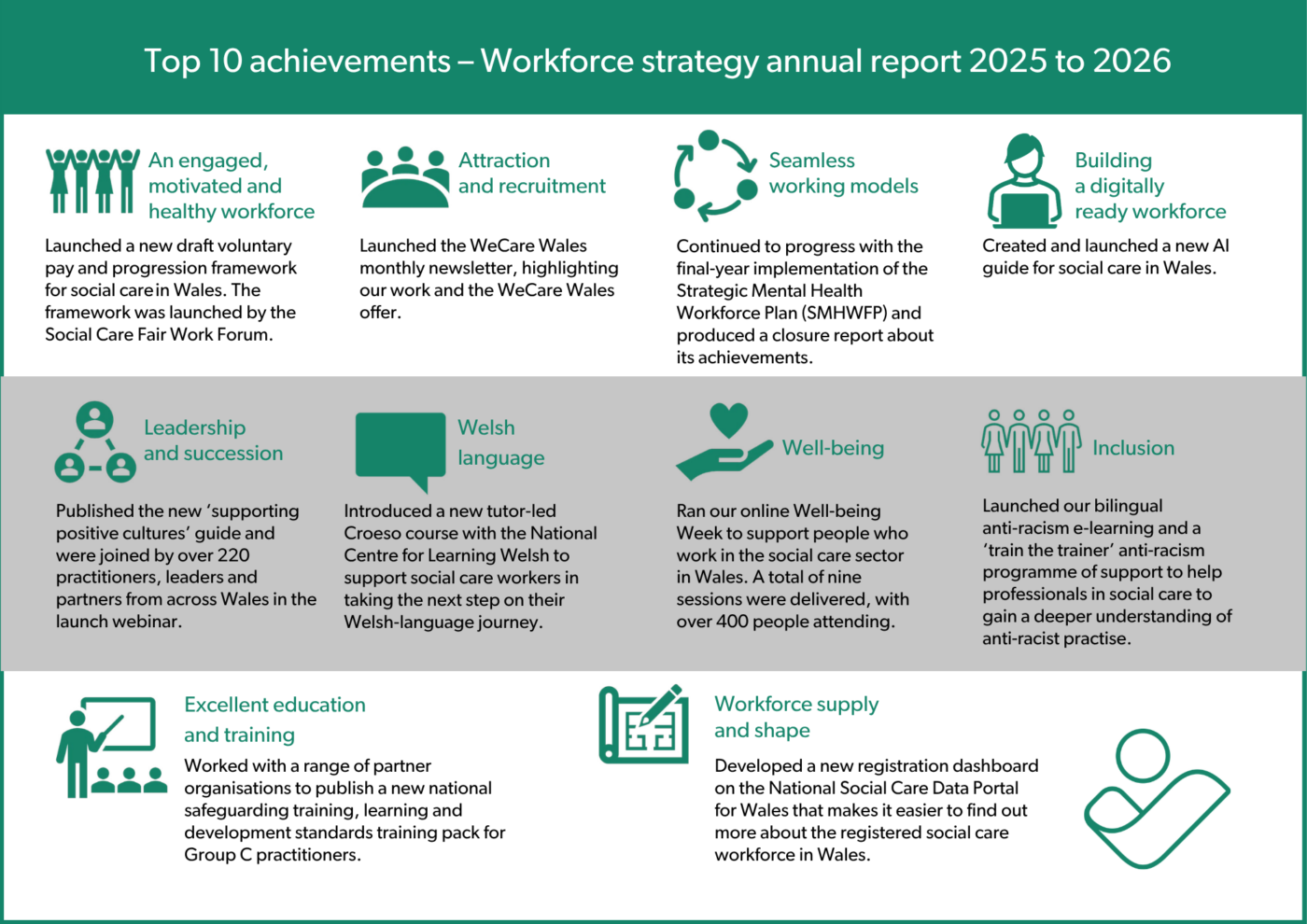
Key highlights from the report
Well-being
- More than 780 people attended our well-being sessions.
- A new digital well-being hub called Ffordd was launched through the strategic mental health workforce plan to support the health and well-being of the mental health and wider workforce.
- We continued to promote the mental health support service ‘Canopi.’
Welsh language
- More than 270 social care workers received support to improve their Welsh-language skills through tutors and online learning.
- We continued to promote the importance of using Welsh at work and shared information on what’s available through the Using Welsh at work webpages.
- A new tutor‑led Croeso course was introduced, in collaboration with the National Centre for Learning Welsh, to help social care workers progress their Welsh-language skills.
Inclusion
- We published the first social care Workforce Race Equality Standard (WRES) report to monitor the experience of staff from Black, Asian and Minority Ethnic backgrounds.
- We launched a pilot leadership programme to support people from diverse backgrounds to progress into leadership roles
- We launched a bilingual anti‑racism e‑learning and a ‘train the trainer’ programme to support anti-racist practice across social care.
An engaged, motivated and healthy workforce
- More than 400 people attended the second Well-being Week with very positive feedback.
- A new draft voluntary pay and progression framework for social care in Wales was launched by the Social Care Fair Work Forum.
- The Social Care Workforce Partnership published its first set of model human resources policies for the social care sector.
Attraction and recruitment
- National recruitment campaigns reached millions of people and promoted careers in areas including children’s residential care, social work, home care and reablement.
- A bilingual Learners Week reached 2,850 primary school pupils across Wales, helping raise awareness of social care careers and roles.
- We celebrated the workforce at our 2025 Accolades awards ceremony, and the 2026 Accolades attracted a record 141 entries.
Seamless workforce models
- Welsh Government published the National Multi-Agency Practice Framework for Children’s Services to support multi-agency working across Wales.
- Partners continued to work together through regional workforce boards and Regional Partnership Boards.
- A new app was launched through the strategic mental health workforce plan to support approved mental health professionals (AMHPs) and Section 12 doctors involved in mental health assessments.
Building a digitally ready workforce
- We shared findings from the digital potential tool to help shape future digital development across the sector.
- We started work on two new interconnected frameworks: a ‘what good looks like’ framework for digital maturity and literacy, and a digital competency framework for leadership.
- We launched a new AI guide for social care in Wales.
Excellent education and learning
- An independent review of social work education pathways was commissioned to address recruitment and workforce challenges.
- A new national safeguarding training, learning and development standards training pack for Group C practitioners was published.
- Wales hosted its first two AMHP conferences to raise the profile of the role and strengthen professional networks.
Leadership and succession
- More than 370 people took part in compassionate leadership training and over 1,500 accessed supporting resources online.
- We launched a new supporting positive cultures guide, attracting over 220 attendees to the launch webinar.
- We published updated Codes of Professional Practice for social care workers and employers in Wales.
Workforce supply and shape
- We launched a new registration dashboard on the National Social Care Data Portal for Wales, providing data and insights on the registered social care workforce in Wales.
- Work began on a new children’s residential workforce delivery plan and an updated social work workforce delivery plan.
- Welsh Government delivered the first stage of the National Care and Support Service implementation plan and published proposals for the next stage.
Explore more evidence around our progress against the strategy's ambitions.